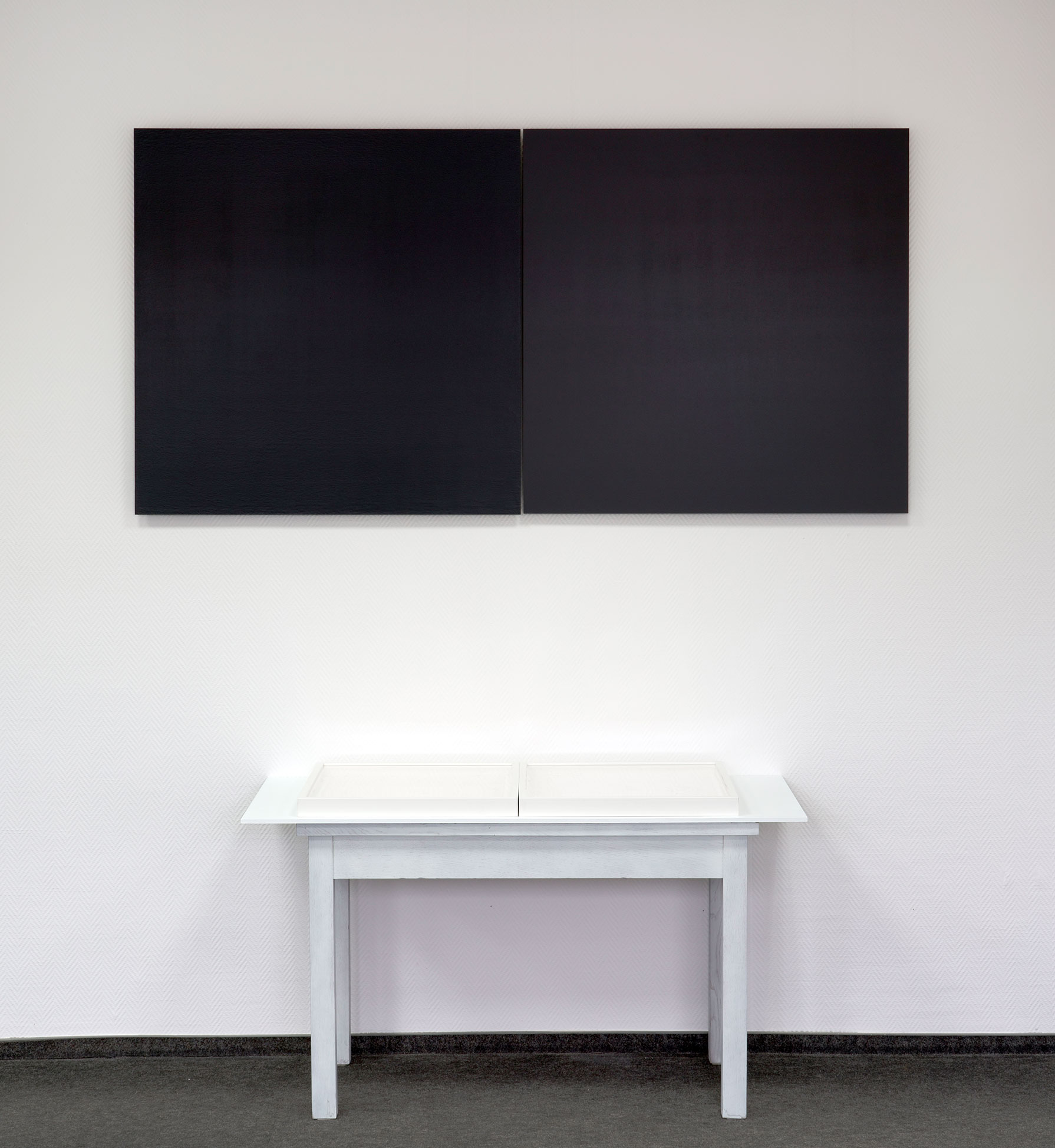
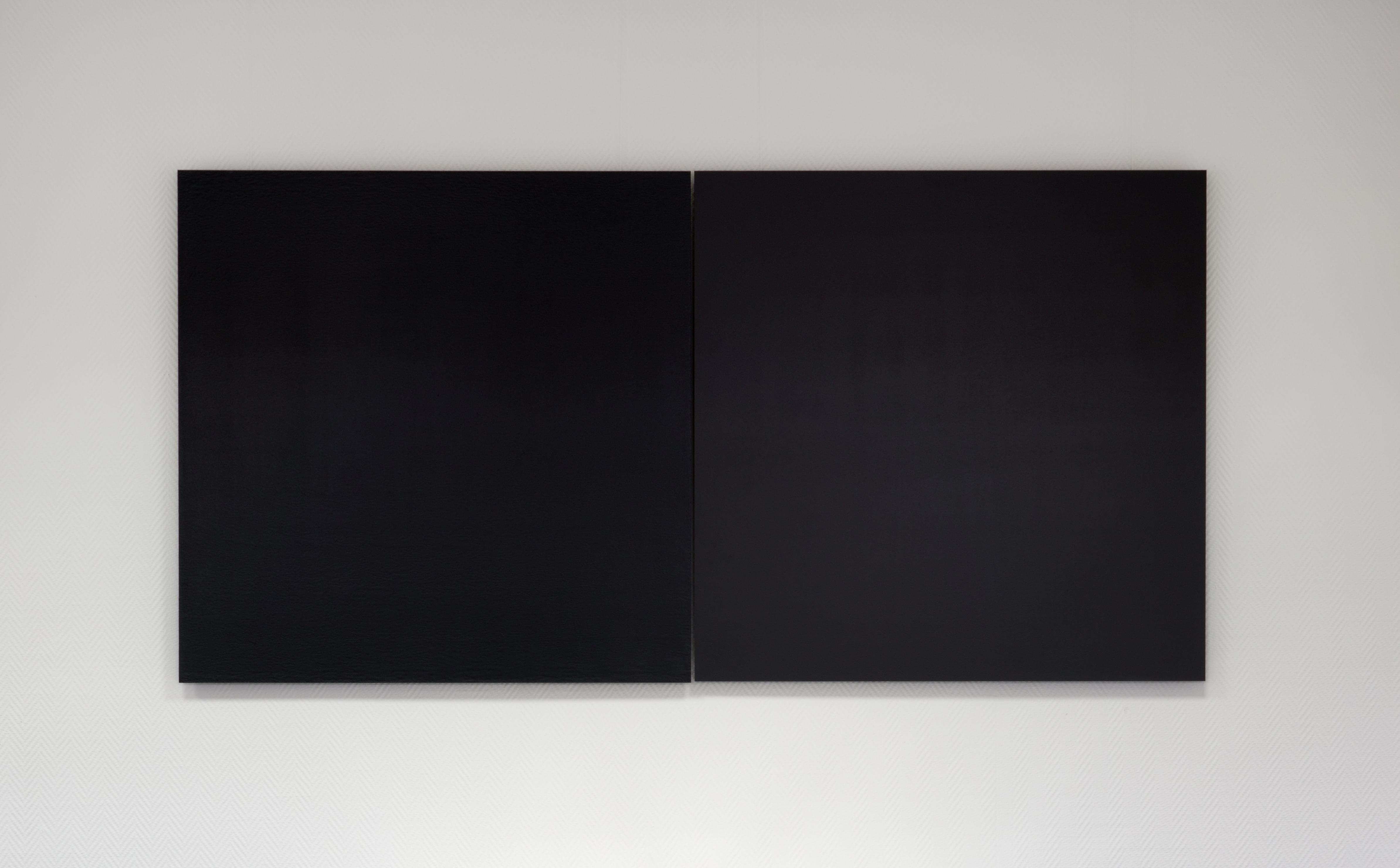
Emptiness I (2020) examines emptiness not as absence, but as a spatially and structurally definable state. The installation is based on reduced geometric elements made of MDF and paint, whose arrangement defines an open space between them. This space becomes the actual center of the work. In contrast to an additive composition, the form of the installation arises from the relationship between the elements and from the space deliberately left free between them. Emptiness appears here as a constructive category—not as a negation of form, but as its prerequisite. The empty boxes define interior space without content and shift attention from the object as a carrier of meaning to the spatial situation it marks. Absence and enclosure thus become primary structural elements of the work. The two wall panels operate via minimal difference. The barely perceptible deviation in the shade of black creates an optical instability: the panels seem to detach slightly from the wall surface and turn minimally into the room. This turns the wall itself into an active field of perception. The work moves between object, architectural reference, and perceptual structure. The individual modules mark boundaries and directions in the space without completely occupying it. This creates a situation in which volume and interspace are perceived as equal. “Emptiness I” addresses the tension between material presence and spatial openness. The installation shifts the focus from the form itself to the relationships between form, distance, and environment, understanding emptiness as an active component of the spatial composition.
Emptiness I (2020) untersucht Leere nicht als Abwesenheit, sondern als räumlich und strukturell bestimmbaren Zustand. Die Installation basiert auf reduzierten geometrischen Elementen aus MDF und Farbe, deren Anordnung einen offenen Zwischenraum definiert. Dieser Zwischenraum wird zum eigentlichen Zentrum der Arbeit. Im Unterschied zu einer additiven Komposition entsteht die Form der Installation aus dem Verhältnis der Elemente zueinander und aus dem bewusst freigehaltenen Raum zwischen ihnen. Leere erscheint hier als konstruktive Kategorie — nicht als Negation von Form, sondern als deren Voraussetzung. Die leeren Kästen definieren Innenraum ohne Inhalt und verschieben die Aufmerksamkeit vom Objekt als Bedeutungsträger auf die räumliche Situation, die es markiert. Abwesenheit und Umfassung werden dabei zu primären strukturellen Elementen der Arbeit. Die beiden Wandplatten operieren über minimale Differenz. Die kaum wahrnehmbare Abweichung im Schwarzton erzeugt eine optische Instabilität: Die Platten scheinen sich leicht aus der Wandfläche zu lösen und minimal in den Raum zu drehen. Dadurch wird die Wand selbst zu einem aktiven Wahrnehmungsfeld. Die Arbeit bewegt sich zwischen Objekt, architektonischem Bezug und Wahrnehmungsstruktur. Die einzelnen Module markieren Grenzen und Richtungen im Raum, ohne diesen vollständig zu besetzen. Dadurch entsteht eine Situation, in der Volumen und Zwischenraum gleichwertig wahrgenommen werden. „Emptiness I“ thematisiert die Spannung zwischen materieller Präsenz und räumlicher Offenheit. Die Installation verschiebt den Fokus von der Form selbst auf die Relationen zwischen Form, Abstand und Umgebung und versteht Leere als aktiven Bestandteil der räumlichen Komposition.